

At some point in almost every argument about inequality, someone reaches for the same line.
“The rich need to pay their fair share.”
It sounds clean. It sounds moral. It gives the crowd a villain and the politician a microphone.
But once you look at the federal income tax system, the line starts to wobble.
The top 10% of earners already pay about 71% of all federal individual income taxes. The top 1% alone pays roughly 38%. The bottom half of taxpayers pays about 3%.
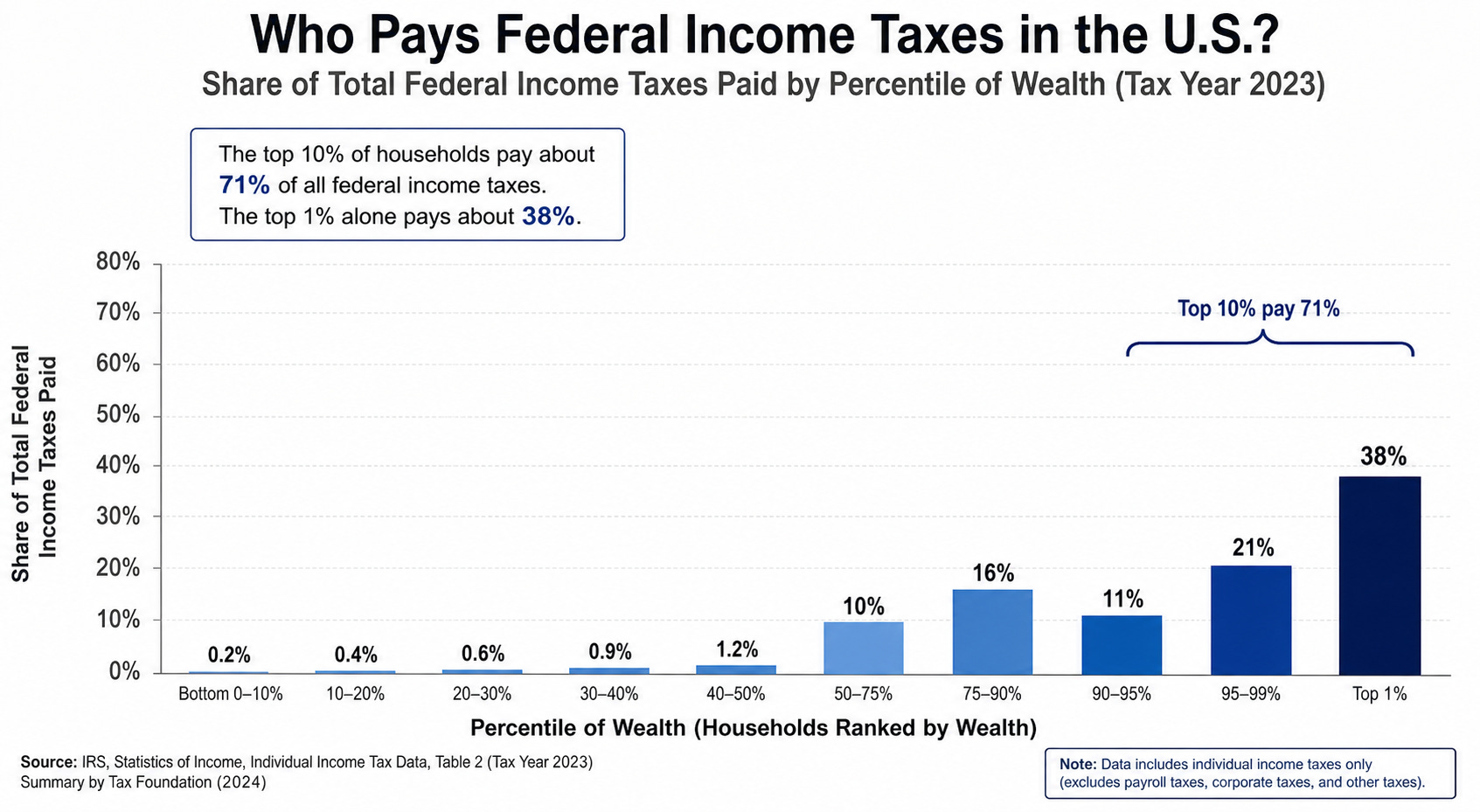
That does not mean every wealthy person is noble. It does not mean the tax code is perfect. It does not mean loopholes, bailouts, crony subsidies, or special carveouts should survive.
It means the story being told at these rallies is too simple.
The May Day protests had a familiar script: workers against billionaires, ordinary people against the powerful, government as the only force big enough to make life fair again. The anger is easy to understand. Housing is crushing families. Groceries feel expensive in a way people can feel every week. Healthcare bills can still wreck a household. A lot of Americans are working hard and feeling like they are falling behind anyway.
That pain deserves to be taken seriously.
But blaming the rich is not a plan. It is a pressure valve.
America’s problem is not that successful people pay too little federal income tax. America’s problem is that government has become too large, too expensive, too indebted, and too comfortable promising things it cannot sustainably deliver.
A country cannot deficit-spend its way into dignity.
When government grows without discipline, the bill always arrives. Sometimes it arrives as taxes. Sometimes as inflation. Sometimes as higher interest rates, weaker growth, regulatory drag, or fewer businesses getting started in the first place. The cost rarely shows up with a neat label. It just makes life heavier.
And who feels that first?
Workers. Renters. Young families. Small business owners. People without assets. People trying to climb.
The same people politicians claim to be protecting.
The better answer is not a larger state with a bigger appetite. The better answer is a freer society with more paths upward.
That means making it easier to build housing so rent does not devour a paycheck.
It means cutting licensing rules that protect incumbents and keep people from earning a living.
It means a tax code ordinary people can understand without hiring a professional guide.
It means schools that give families real options, including vocational paths and apprenticeships, rather than trapping children in systems that fail them because of where they live.
It means sound money, because inflation is one of the cruelest taxes in America. It hits the grocery cart before it hits the yacht.
It means treating entrepreneurship as a public good, not a loophole for the ambitious.
The American Dream was never a promise that everyone would end up in the same place. It was the promise that your starting point did not have to become your ceiling.
That promise needs oxygen. It needs room to move. It needs a government strong enough to protect basic rights and restrained enough to leave people space to build their own lives.
The rallies are right about one thing: too many Americans feel stuck.
But they are aiming their anger at the wrong target.
The enemy is not the founder who built a company, the doctor who worked brutal hours, the investor who took risk, or the executive whose income already funds a large share of the federal income tax base.
The enemy is a system that makes housing scarce, schools uneven, healthcare opaque, businesses hard to start, money less stable, and government programs impossible to pay for without borrowing from the future.
If we want more people to rise, we should rebuild the ladder. We should stop sawing at the top rung.
A freer economy is not a gift to the rich. It is how more people become less dependent on politicians, bureaucracies, and slogans.
That is the part of the American Dream worth defending.
Not envy. Not dependency. Not permanent resentment dressed up as justice.
The real dream is still older, tougher, and better than that: work hard, take responsibility, build something, own something, improve your life, and give your children a better shot than you had.
That dream does not need another tax hike.
It needs a government that gets out of the way.
Thoughtful piece, and I want to engage it seriously because there's real common ground here — I agree the tax code is a mess, that zoning reform and occupational licensing are quietly progressive issues, and that envy makes a lousy foundation for policy. But I think the chart at the center of your argument is doing more work than it can honestly bear.
Federal income tax is a tax on wages and realized gains. It is not a tax on wealth, and for the people at the very top, wages are a rounding error. A billionaire whose shares appreciated $4 billion last year shows essentially zero "income" on a tax return until they choose to sell. They can borrow against that gain, live on it, plan estates around it — but the IRS sees nothing. When ProPublica got the actual returns of the wealthiest Americans, the "true tax rate" on wealth growth came in below 4% for several of the most famous names. A schoolteacher pays a higher share of her economic gain than that, automatically, every year.
So yes — the top 10% pays 71% of income tax. That mostly tells us the middle class has hollowed out and a lot of professionals (surgeons, senior engineers) are now classified as "rich." It tells us very little about whether the people who actually own the country's productive assets contribute proportionally to the system protecting those assets.
And the concentration matters because the gains have stopped circulating. Productivity has roughly doubled since 1980; median real wages for non-supervisory workers have barely moved. The top 1% now holds more wealth than the entire middle 60% combined. Median home prices went from ~3x household income to ~6x. Medical bills remain the leading cause of personal bankruptcy — a sentence that wouldn't parse in any other developed country. 40% of adults can't cover a $400 emergency. Diabetics ration insulin. Life expectancy has fallen in exactly the working-class communities your essay says are being failed. They are. But not by progressive tax policy.
On government being "too large" — I'd gently push back. U.S. federal spending as a share of GDP is lower than nearly every peer democracy. Germany, France, the UK, Canada, the Nordics, Japan all spend more and deliver universal healthcare, paid leave, subsidized childcare, real public transit, affordable higher ed. We deliver none of that reliably and still run deficits. Why? Because our revenue as a share of GDP is dramatically lower than theirs. The CBO has been pretty clear that most projected debt growth is driven less by new spending than by revenue that was structurally cut — Bush cuts, Trump cuts, the preferential capital gains rate, carried interest, step-up in basis at death, the Social Security payroll cap at $168k — and never restored. The deficit isn't primarily a spending story. It's a revenue story we've been told not to look at.
And on the "you'll kill the incentive" objection: a person worth $1B and a person worth $100B live identical lives. Same meals, same houses (more of them, but they sleep in one at a time), same doctors, same schools, same access. The lifestyle curve flattens completely somewhere in the low nine figures. What changes above that isn't motivation — it's power. Steve Jobs didn't work harder because of estate-tax policy. The doctor pulling 80-hour residencies isn't grinding for the delta between a 35% and 39.6% bracket. The high-tax, high-investment postwar era produced more upward mobility and more new business formation per capita than the low-tax era we've lived in since 1980. The motivation thesis is empirically thin.
You wrote that the dream is "work hard, take responsibility, build something, own something." I want that dream too. But it depends on owning something being achievable, and right now for most Americans under 40 it isn't — not because they don't work hard, but because the share of national wealth available to people who don't already have wealth has collapsed.
That's not envy. That's arithmetic. And fixing it doesn't require villainizing anyone — just being honest that an economy where the top 0.1% captured most of four decades of growth isn't the natural outcome of merit. It's the outcome of policy choices, and policy choices can be revisited.
Your chart in the post isn't lying, but it is selective. It’s like looking at a photo of a clean kitchen while the rest of the house is on fire.
If we’re going to talk about who’s carrying the weight of the country, we have to look at the whole ledger, not just the "Federal Income Tax" column.
1. Federal Income Tax isn't the only bill in the mail.
The post makes it look like the bottom 50% are getting a free ride. But federal income tax is just one flavor of tax. Most Americans get hit hardest by payroll taxes (Social Security and Medicare), which are flat and actually stop being collected once you hit a certain income ceiling ($168,600 in 2024).
The Reality: When you add in sales tax, property tax, and state taxes, the "tax gap" starts to close. Lower-income families often pay a much higher percentage of their total earnings into these systems than a billionaire does.
2. Wealth vs. Income: The "Capital Gains" Loophole
The wealthy pay a lot of income tax, but they don't get their wealth from a "paycheck" like the rest of us. They get it from assets.
If you work 60 hours a week as a surgeon, your income is taxed at a high rate.
If you sit on a pile of stocks that grow by $10 million, you don't pay a cent until you sell-and even then, it’s often at a Capital Gains rate (approx. 20%), which is significantly lower than the top income tax bracket.
A 2021 study showed the 400 wealthiest families paid an effective rate of just 8.2% when you count their total wealth growth. That’s less than what many teachers pay.
3. The "Government as the Enemy" Fallacy
The post frames the government as a parasite on the "founder." But let’s be real: no one builds a billion-dollar company in a vacuum.
The Foundation: Founders use public roads to ship goods, a public-educated workforce to run the machines, and a taxpayer-funded legal system to protect their patents.
The R&D: The "tech" in your iPhone? Much of it (GPS, the Internet, Touchscreens) started as government-funded research. Taxing the winners of that system isn't "punishment" -it’s a reinvestment in the infrastructure that allowed them to win in the first place.
4. Inflation isn't just "The Government’s Fault"
The author calls inflation "the cruelest tax." They’re right. But blaming it solely on government spending is a massive oversimplification.
Profit Margins: In the last few years, corporate profits hit record highs. While the "cost of eggs" went up for us, the companies selling them were reporting their best years ever.
If we’re going to talk about "fairness," we have to ask why the "ladder" is being pulled up by the same people who benefited from it when it was still intact.
The Bottom Line:
We don't need a bigger state just for the sake of it, but we do need a system where the "share" is actually proportional to the total benefit received.
You can't claim the system is "unfair" to the rich while the top 1% holds 30% of the nation's wealth. The ladder isn't broken because the rich pay too much; it’s broken because the rungs are getting further apart.